
How Do Airbag Massage Systems Work?
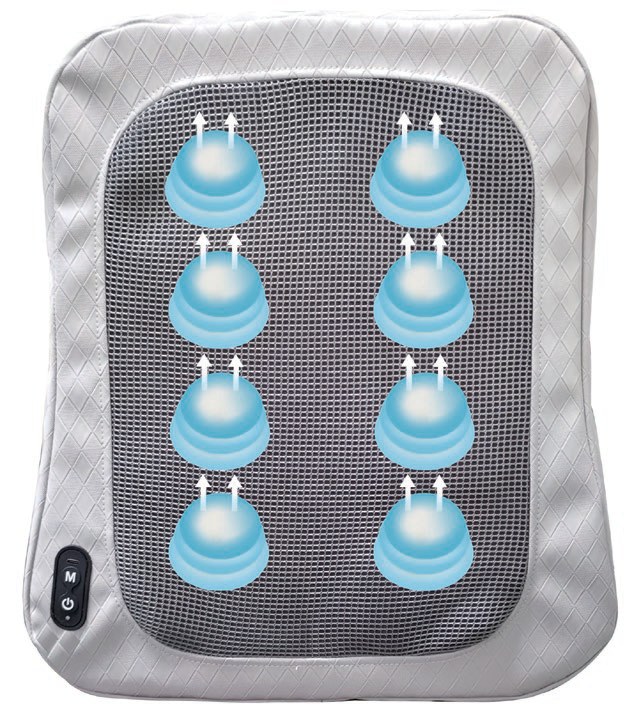
An airbag massage system works by squeezing, not by striking. Sealed air chambers inflate against the body, hold the pressure for a moment, then deflate — driven by an air pump and valves rather than by any motor or roller. The cycle repeats across one chamber or several, paced by the timer in the control electronics. At Wellness this mechanism ships in two different product families: airbag components that furniture OEMs build into chairs and recliners, and finished massage devices that consumers use straight out of the box. The airbag massage system category gathers both sides of the catalog, including models like the 8 airbag lumbar massage system W1704 and the 4 airbag massage system W6A26.
- Rhythmic pressure comes from inflating and deflating air chambers; timers and modes live in the control electronics.
- Airbag count and zone layout decide where pressure lands — not how strong it feels.
- The catalog runs from a 4-airbag kit with integrated heating up to an 8-airbag rechargeable lumbar pad and multi-zone finished mattresses.
- Finished devices and furniture-integrated components run on the same pneumatic principle yet differ in power supply, housing and installation.
MechanismHow does an airbag massage system work?
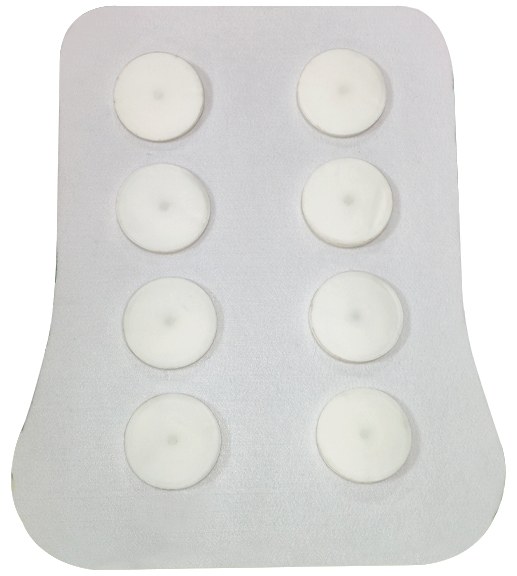
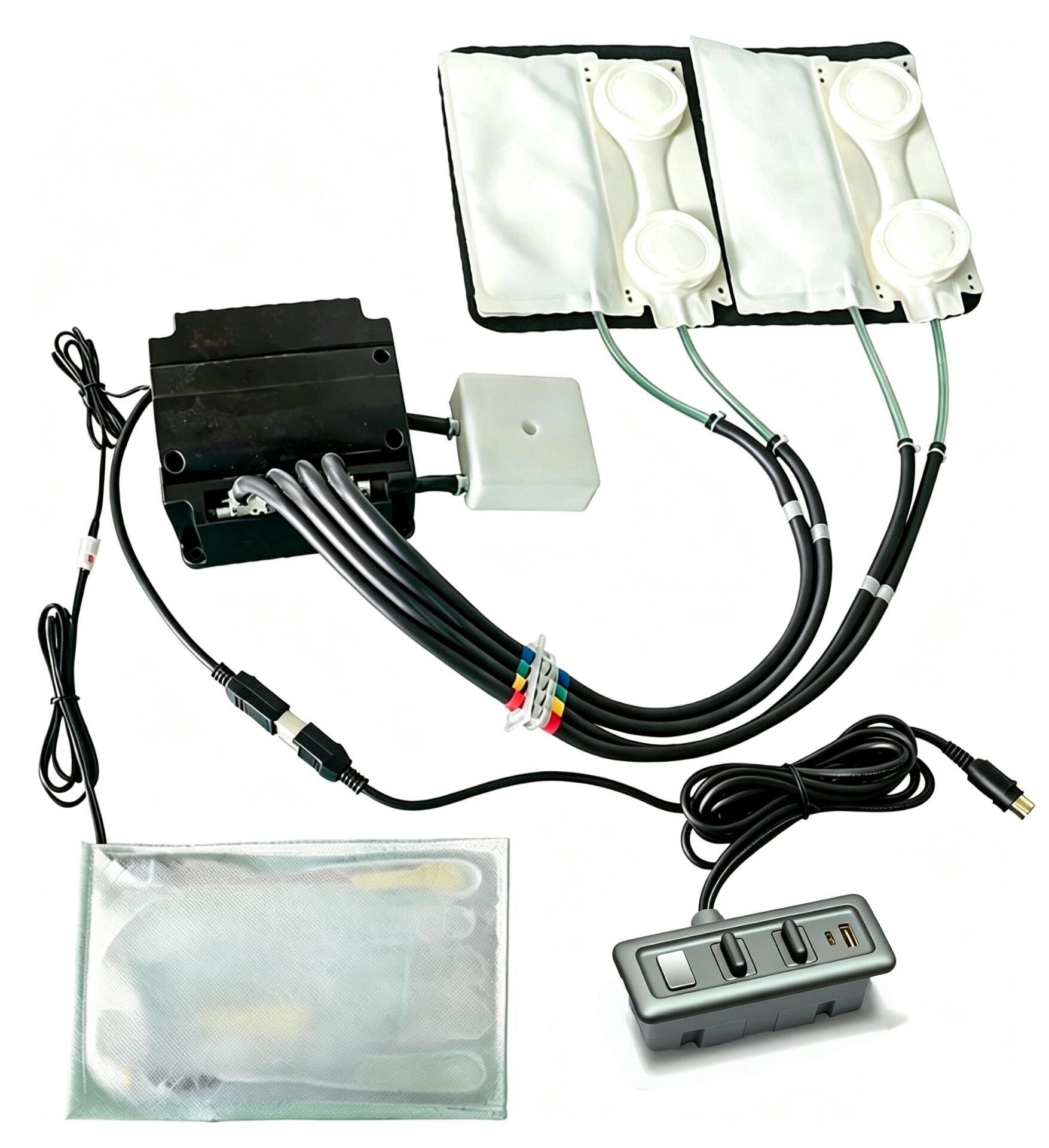
Three parts do the work: an air pump, a valve assembly, and one or more air chambers (airbags). The pump builds pressure. The valves decide where it goes — routing air into a chosen chamber, then venting it out again. A single-chamber sequence is simple enough: inflate, hold, deflate, rest, repeat. Multi-chamber systems take it further by grouping chambers into zones that fill in sequence or in pairs. The W1704 pillow, for example, lists 8 airbags that massage in turn with independent node control.
What separates one model from the next is the pneumatic hardware inside. The published specifications for the W1704 component confirm 8 airbags, 3 modes, a 10-minute timer and a rechargeable 7.4V/1000mAh battery charged at 5VDC/2A — but the pump and valve configuration is confirmed per project, not printed on the page. That is how the category usually works. Pump type, valve layout, pressure levels and connector details all depend on the housing, the target feel and the host furniture. So when you compare an air compression massage system, ask for those pneumatic details explicitly; the request a quote route is where project-specific technical documentation comes from.
FeelWhat does an airbag massage feel like compared with vibration or kneading massage?
Vibration massage leans on a motor oscillating a contact surface at high frequency. Kneading massage uses rotating or moving rollers to press and roll across muscle groups. Airbag massage sits apart from both: pressure builds slowly as the chamber inflates, holds, then lets go. What you feel is a squeeze — closer to a firm hug than to a buzz or a rolling stroke.
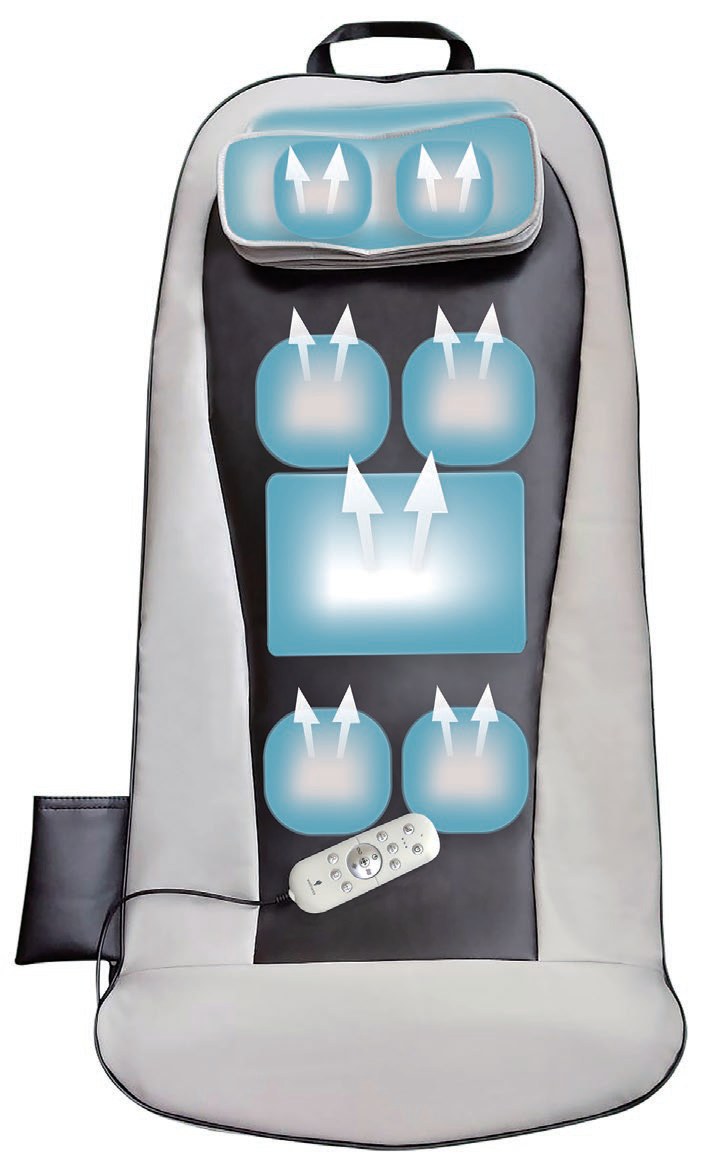
Contact area is the other dividing line. A vibration motor or roller head works on a small footprint that travels across the back. An inflated chamber covers a wider area in one go — the W706A mattress applies air compression over neck, shoulders, lumbar and buttock, while the Shiatsu Massage Cushion W292 pairs 4 heated moving rollers for the back with air inflation for waist and hips. For buyers the question is never which mechanism is “better” — it is which sensation matches the product: kneading for a mechanical, roller-style feel; airbags for broad, rhythmic pressure; vibration for compact, low-cost surfaces.
ConfigurationHow many airbags does a massage system need?
There is no magic number — the count follows the zones you want to cover and how independently they need to run. A 4-airbag massage system like the W6A26 suits a limited pressure target, lumbar support in a recliner, say, with the controller sequencing four chambers. Eight airbags, as in the W1704 component, spread pressure across a wider lumbar area and give the sequencing more granularity.
Several catalog models describe layout by zone instead of chamber count. W706A-4AIR runs on 12VDC with 3 modes and selectable 10/20/30-minute heating and airbag timers. W6504AIR combines a 4-zone airbag massage with dual linear actuators and 3 modes on a 30-minute timer. W7A02HB is a 2-air compression model with 3 modes and a 30-minute airbag timer. None of these listings publishes pressure values or pump specifications, so read airbag count as a layout indicator — then confirm pressure and cycle behaviour with the supplier before you commit.
| Model | Airbag layout | Modes | Timer | Power / heat |
|---|---|---|---|---|
| W1704 (component) | 8 airbags | 3 | 10 min | Rechargeable 7.4V/1000mAh battery; charge 5VDC/2A |
| W6A26 (component) | 4 airbags | Not published (2-motor push-rod controller) | 20 min airbag; 30 min heating | 29VDC/2A; 29W heating element |
| W706A-4AIR | 4-zone airbag | 3 | Heating and airbag 10/20/30 min selectable | 12VDC |
| W6504AIR | 4-zone airbag + dual linear actuators | 3 | 30 min | [DATA REQUIRED] |
| W7A02HB | 2 air compression | 3 | 30 min | [DATA REQUIRED] |
| W6A06 | [DATA REQUIRED] | [DATA REQUIRED] | 30 min | [DATA REQUIRED] |
HeatCan airbag massage be combined with heating?
Yes — and it is a common combination. Heating works as an optional layer inside the same control electronics, and the catalog includes both combined and air-only models. The W6A26, for instance, pairs 4 airbags with a 29W heating element and keeps the timers separate: 20 minutes for airbag massage, 30 minutes for heating. The separation matters because heat and pressure are independent functions; a product can run a heat-only session without ever inflating a chamber.
Finished devices follow the same logic. The Shiatsu Massage Cushion W292 pairs 4 heated moving rollers with air inflation for the waist and hips. The Air Compression Massage Mattress W706A delivers air compression, with no heating element listed in the supplied specifications. If heating is in your spec, confirm heater wattage, temperature behaviour and whether the two timers run independently — those choices shape control design and safety review far more than the pneumatic principle itself.
See how these combinations appear in consumer-facing products across the Finished massage devices range.
ApplicationWhere are airbag massage systems used — finished devices or furniture components?
Wellness keeps the two routes separate because they carry different engineering and commercial requirements.
Furniture-integrated components. These are modules a furniture OEM builds into a recliner, chair or seat. The massage components and systems line carries airbag pads and kits designed for embedding. The W1704 rechargeable lumbar pad is a self-contained component with its own battery and timer, while the W6A26 is a 4-airbag kit with a 2-motor push-rod controller and a 29W heating element, powered at 29VDC/2A. Wiring, connectors, mounting and how the module is triggered from the host furniture — all of that gets confirmed per project.
Finished devices. These are complete, consumer-ready products with housing, controls and packaging. The Air Compression Massage Pillow W1704 is cordless for use while walking, sitting, working or driving, with 8 airbags massaging in turn, independent node control and 10-minute auto-off. One naming note to prevent confusion: the W1704 in this finished-device entry and the W1704 lumbar massage component listed under massage components and systems are two separate catalog items — the component serves furniture OEMs, the pillow is a retail-ready product — and each is specified on its own page. The Air Compression Massage Mattress W706A offers low/medium/high compression levels (default medium), inflates and deflates to massage neck muscles with a left-right twist, folds for storage, and includes a home adapter with 10/20/30-minute timer selection.
The real trade-off is development scope. Take the component route and the furniture design, upholstery, branding and certification pathway stay with the OEM. Take the finished-device route and you inherit the enclosure, retail packaging and market documentation that come with it. Neither route changes the pneumatic mechanism, but both shape testing, power supply design and after-sales support.
SourcingWhat should buyers check before sourcing an airbag massage system?
Start with pneumatic documentation. Pump type, valve count and layout, working pressure and connector details are not published for these models — they are confirmed per project through technical documentation. Ask for a drawing or specification sheet that spells them out, and treat any quote that skips this detail as incomplete for engineering review.
Next, power architecture. The W1704 component runs on a rechargeable 7.4V/1000mAh battery charged at 5VDC/2A — the fit for products where cordless use matters and charging infrastructure is acceptable. The W6A26 and W706A-4AIR take DC input (29VDC/2A and 12VDC respectively), which suits mains-powered furniture and fixed installations. Going rechargeable adds battery certification and charging-time considerations; going mains shifts those requirements into the host product.
Third, control and timer behaviour. Airbag timers in the catalog range from 10 minutes (W1704 component) through 20 minutes (W6A26 airbag) to 30 minutes (W6504AIR, W7A02HB, W6A06). On modes, the published listings are not uniform: most published airbag models list 3 modes, while the W6A26 is specified through its 2-motor push-rod controller rather than a mode count. Whatever a listing shows, unpublished mode details are confirmed per project — so ask what each mode actually changes, whether that is sequence, zone pairing or intensity. A mode label on its own does not define the pneumatic sequence.
Finally, commercial fit. Listed minimum order quantities run 1,000 pieces for the W1704 and W6A26 components, and 500–1,000 pieces for the finished pillow, mattress and cushion; lead time for the W1704 is listed at 15–45 days. Credentials deserve a separate check as well. Wellness holds ISO management system certification, environmental management system certification and BSCI social compliance assessment — company management-system credentials, not product certifications — and even these do not replace product compliance in your target market.
ConclusionDesign the pneumatic layer around the product, not the other way round
Strip it back and an airbag massage system is just a pump, a set of valves and chambers controlled in time. The W1704 component and W6A26 show how far that configuration can stretch — 8 airbags on a rechargeable battery versus 4 airbags with an integrated 29W heater and a 2-motor controller — while the finished W1704 pillow, W706A mattress and W292 cushion prove the same mechanism works in retail form. If you are specifying one, work in this order: define the target zone, the power source and the heating requirement first, then confirm pump, pressure and connector details with the supplier — before you commit to tooling or packaging.
OEM/ODM next step
Planning to integrate airbag massage into a recliner, chair or seat, or to launch a private-label finished device? Send us your zone layout, power requirement and target timer behaviour, and we will confirm the pneumatic configuration and commercial terms for your project. Start with OEM/ODM or request a quote.