
How to Choose Between Handheld and Wearable Massage Devices?
Handheld and wearable massage devices answer two different buyer problems. The handheld form is held in the hand and guided across a body area; the wearable form is worn on the body and stays in place while the user does something else. That single mechanical difference drives everything a private label buyer has to decide: how the product sells, how it is packaged, what battery architecture it needs and what the program around it looks like.
Below is a working framework built around four finished products from our Massage Devices line — two handheld and two wearable — so each trade-off has a concrete reference rather than a generic claim. The same logic applies whether you are expanding a catalogue or choosing a first SKU.
What is a handheld massage device?
A handheld massage device is gripped in the hand and moved over the target area by the user. The user controls pressure, angle and duration in real time. That makes the handheld form attractive when the massaging action itself has to be directed — percussion heads on a deep muscle, kneading on the abdomen — but it also means the user keeps holding it throughout the session.
Two handheld products in our line show how wide that category is:
- The Mini Massage Gun W1600 is a percussion tool: deep tissue massage for full-body relaxation, 4 speed levels and 4 massage heads. The small head is for stiffness, the U head for spine muscles from the neck down to the lower back, the A-type head for trigger points and the flat head for direct percussion. It runs on a built-in 800mAh battery.
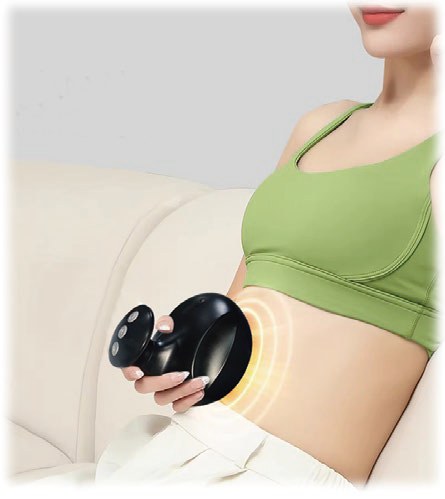
- The Handheld Abdominal Massager W3040 is a kneader, not a percussor. It rotates in both directions, offers two modes and three gears, uses a natural Sibin stone needle with red light, and kneads the abdomen at multiple points to relax abdominal muscles and relieve bloating or indigestion discomfort.
These two are the same form factor carrying entirely different functions. For a buyer, that matters more than the label on the category page: a mini massage gun and an abdominal kneeder do not compete with each other on a shelf, they compete for a specific consumer use case.
The practical cost of the handheld form is that it cannot be worn. It also concentrates the spec burden on the grip and the head design, because the user's hand is the interface. If a private label program wants a product the consumer feels actively engaged with — even for a short session — handheld is the natural choice.
What is a wearable massage device?
A wearable massage device is fixed to a body site — over the eyes, around the neck — and massages without the user holding it. The user sets the program and then can sit, recline or move. The trade-off is that the device cannot reach any point the user chooses; it only works where it sits.
Two wearable products in our line illustrate that trade:
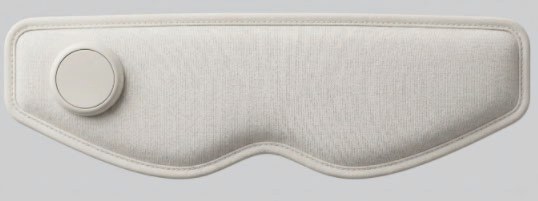
- The Eye Massager W3047 is worn over the eyes. Soft silicone multi-point massage runs with constant temperature heating, the material is breathable woven fabric, and the ergonomic nose recess avoids compression on the nasal bridge. It is controlled by a single push button and runs on a built-in rechargeable battery for wireless use at home, in the office or on travel.
- The Rechargeable Neck Massager W3017-B is worn around the neck. It delivers powerful shiatsu with clockwise and anticlockwise rotation, combining kneading, rolling and heating functions. The battery is a 12V 2200mAh lithium pack, with about 2–3 hours of working time per charge.
Wearable devices tend to sell on fit and comfort rather than on force. The eye massager's nose recess and breathable woven fabric are the kinds of detail a buyer can test on a sample and a retailer can advertise on pack. The neck massager's bi-directional shiatsu covers a region the hand cannot easily work itself, which is exactly why the wearable form exists.
Which form factor fits private label programs better?
Neither form factor is "better" in the abstract. The question is what the program around it can support. A useful way to make that decision is to separate the things that change with form factor from the things that stay the same.
| Decision point | Handheld (W1600, W3040) | Wearable (W3047, W3017-B) |
|---|---|---|
| How the user interacts | Holds and guides the device; pressure is controlled by hand | Sets the program, then releases the device; fit carries the pressure |
| Body coverage | Any point the user can reach — full body for W1600, abdomen for W3040 | Only the site it is worn on — eyes or neck |
| Battery and cord | Built-in 800mAh pack, cord-free during use | Built-in rechargeable pack (eye), 12V 2200mAh with 2–3 hours working time (neck) |
| Program signal | Tool-like; head and speed choices visible on the product | Comfort-like; fit, materials and heating are the selling points |
A handheld line usually needs more accessory or head options to feel complete to the consumer, which multiplies the number of parts a private label buyer has to manage. A wearable line typically concentrates on one strong comfort claim. Which of those is easier for your brand depends less on the device and more on how much kit your packaging and after-sales can absorb.
Which is better for private label programs: handheld or wearable?
If your brand story is about activity and recovery — a tool the consumer uses deliberately — put handheld first. The mini massage gun and the abdominal kneader are both easy to frame as purposeful products, and their visible features (heads, modes, gears) give you something to print on pack. If your brand story is about a calm, passive routine — eye care, neck relief while sitting — put wearable first. The eye massager and rechargeable neck massager are easier to position as everyday-use products.
MOQ also shapes the answer. Per our current client documents, the W1600 and W3047 sit at 500–1,000 pcs, while the W3040 and W3017-B are listed at 1,000 pcs. Lead time is 45 days in the same documents. Please confirm MOQ and lead time with our sales team before you set a launch plan, because those values are quoted from current records, not fixed for every program.
You can review the full handheld range on the massage guns category page, and the wearable range on the eye massagers, neck massagers and abdominal and waist massagers category pages.
How do battery and charging designs differ between the two?
Battery architecture follows the form. A handheld device has to power a percussion or kneading motor that runs while the hand applies pressure; a wearable device has to power a smaller mechanism while the user is not gripping it, which puts more emphasis on weight and on running quietly. Both are cord-free during use in our line, but the configuration differs.
The W1600 carries a built-in 800mAh battery in a compact body. The W3017-B carries a 12V 2200mAh lithium pack with about 2–3 hours of working time, because a neck device is expected to run for a longer sitting session. The W3047 also has a built-in rechargeable battery for wireless use. What a buyer should check first is not raw capacity but whether the device's intended session length matches the user routine your brand will describe on pack. Our published product pages list the battery values; we do not quote a run time for every model here, so confirm any figure your brand intends to publish.
Can a brand carry both handheld and wearable lines?
Yes, and many programs do — but the case for both rests on complementarity rather than volume. Handheld and wearable devices solve different moments: a handheld percussion tool for targeted recovery, a wearable eye or neck device for a passive routine. Carrying both gives your brand a fuller story, but it also means two sets of packaging, two spec sheets and two MOQ commitments in the same program.
A practical way to sequence it: launch the form factor that fits your brand story, confirm how the samples fit on the target consumer, then add the second form once the first has a settled MOQ and packaging plan. OEM/ODM customization — housings, branding, packaging and controls — is where the two lines can share a design language. Details of that process are on the OEM/ODM cooperation page.
- Choose handheld when the device must be guided and the consumer is an active user; choose wearable when fit and comfort carry the proposition.
- Check battery configuration against the session length your packaging describes, not against capacity alone.
- Set MOQ and lead time from our current documents with sales before you lock a launch plan.
If you want to see whether a handheld or wearable line fits your program, request a quote with the product, target market and packaging direction — our sales team will respond with current MOQ, lead time and available options.