
How to Source a Waterproof Outdoor Pet Heating Pad
Purchasing guide · Pet heating and cooling mats
Outdoor placement changes what you need from a heated pet mat. A pad that performs fine on a living-room floor may face damp bedding inside a doghouse, a dog that chews its bedding, condensate under the mat, and owners who leave the power connected for weeks. This guide sets out what a waterproof outdoor pet heating pad should specify, how to check each feature against the failure it is meant to prevent, and how to match pad and model to the dogs and shelters you are buying for.
Key takeaways
- Water resistance in an outdoor heating pad is a material and construction question, not a single label. Ask which layers are water-resistant and how the seams and cord entry are handled.
- Low-voltage DC power (12V in the models discussed here) and a chew-resistant cord are the two electrical points buyers raise most often for doghouse and exposed-shelter use.
- Heat control levels decide how many SKUs you carry: fixed-output, H/L two-level, or H/M/L three-level with a timer.
- For large dogs, treat sizing as a separate selection step: request drawings and measured dimensions instead of assuming the small pad scales up.
- MOQ 1,000 pieces and a 45-day bulk lead time apply to the reference models below; treat both as starting points to confirm per order.
Why outdoor use raises the specification bar
Indoor heating pads are judged mainly on comfort and surface feel. Outdoor pads are judged on the operating conditions around the pad: moisture from the ground and from the animal, bedding that gets dragged or chewed, and long unsupervised running hours. Each of those conditions maps to a specific component in the bill of materials, so the sensible way to source is to work backwards from the failure you are trying to avoid.
| Outdoor condition | What it stresses | Feature to specify |
|---|---|---|
| Damp floor, condensation, wet paws | Outer cover, internal layers, seams | Water-resistant fabric or waterproof easy-clean liner |
| Dogs chewing bedding and cables | Cord jacket, connection points | Chew-resistant cord |
| Exposure and unsupervised use | Electrical supply and user safety assumptions | Low-voltage DC supply (12V DC adapter) |
| Variable weather and animal size | Output settings | Multi-level heat control; timer where available |
| Persistent power connection | Power management by the owner | Clear instructions on unplugging when not in use |
Evaluating each feature, one by one
Water-resistant fabric and lining
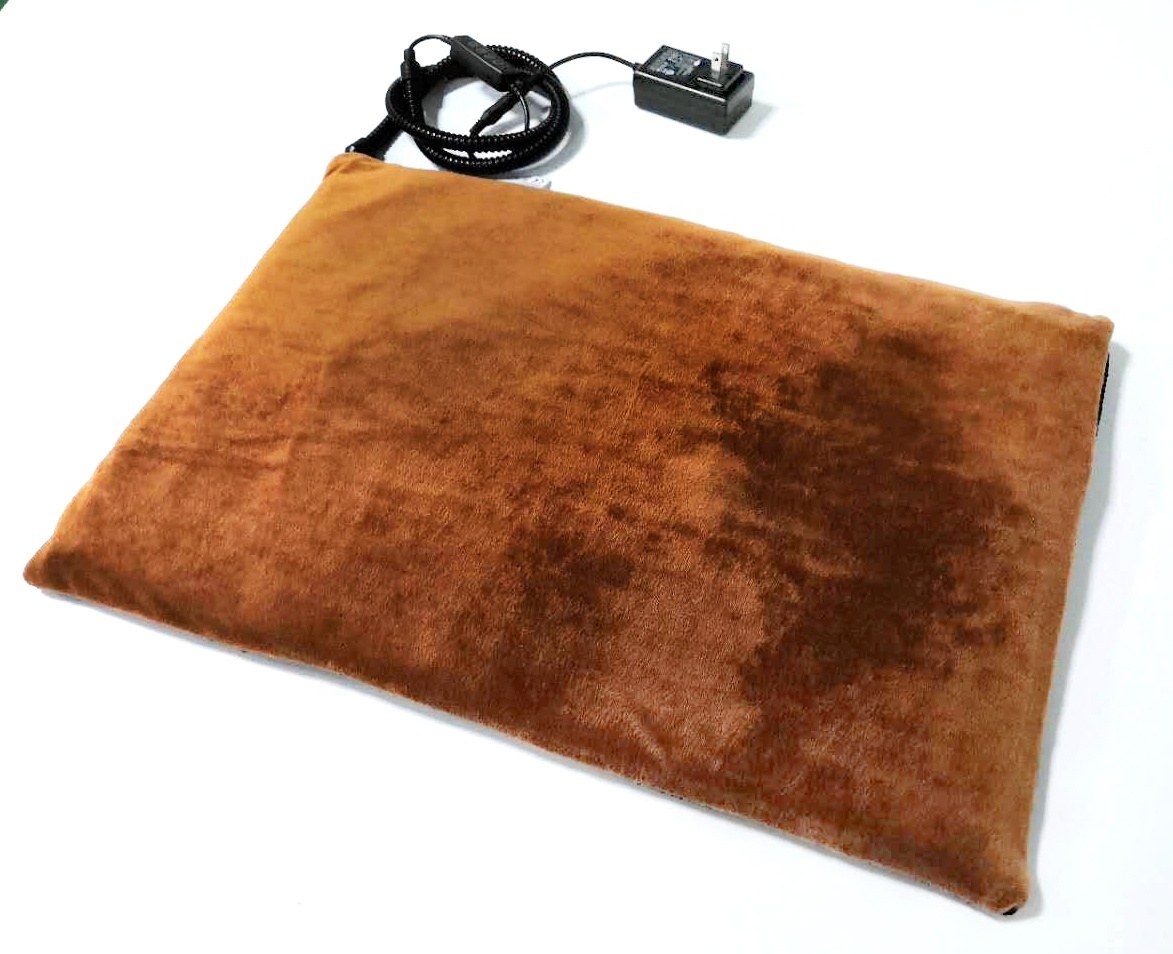
"Waterproof" is used loosely across the category. What you can actually compare across suppliers is the layer stack: which surface the animal contacts, which layer resists moisture, and what sits beneath. The two reference models below show the difference in practice. The Pet Heating and Massage Pad W2037M is listed with a material stack of short-pile fabric plus waterproof fabric plus ABS and a water-resistant, easy-clean lining; the Pet Heating Pad W2037 is listed as suitable for indoor and outdoor use including doghouses. Quote the layer stack in your inquiry and treat it as a build description, not a performance verdict: whether a given build stands up to a wet doghouse floor is a test condition you agree with the supplier, not something the material list alone proves.
Two cautions for your spec sheet. First, a fabric description does not by itself describe immersion or standing-water performance, so if your channel expects pads to survive a wet doghouse floor, state the test condition you want and ask the supplier how the pad is qualified against it. Second, the cover is only one part of the moisture question — the seams, the cord entry and the control housing are the three junctions where water usually gets in, so ask specifically how each of the three is sealed. How a supplier answers that question is itself a comparison point: a concrete structural answer lets you judge between two factories, while a generic "it is waterproof" tells you nothing.
Chew-resistant cord
A chew-resistant cord is listed on the W2037 model. This matters for doghouse use because the cord often runs across the shelter floor and through bedding. When you evaluate this feature, ask what the resistance applies to: the jacket material, the gauge, or both. Also confirm the cord length, since a cord that is too short forces an extension lead inside the shelter, which reintroduces the same exposure. Cord length is not fixed in the specifications available here, so make it an explicit line item in your inquiry, and check both jacket thickness and the connection point where the cord leaves the pad when you inspect the sample.
12V DC supply
All three reference models run from a 12V DC adapter. From a procurement standpoint, this determines the input voltage your retail listing must state, the adapter type you must ship in the box, and which market's plug you need. Where the adapter is a separate component, its plug standard and any regional variants belong in the purchase specification — the pad spec alone does not settle that. Also confirm what the adapter is rated to deliver, because the adapter rating is not stated for the models here. Leaving it open affects three downstream items: the voltage and wattage printed on your retail packaging, the plug variants you have to stock per market, and what goes in the box, so fix it in writing before production rather than at inspection.
Heat levels and timer control
The control scheme decides your SKU range and your price ladder more than any other feature. Three patterns appear across the range here:
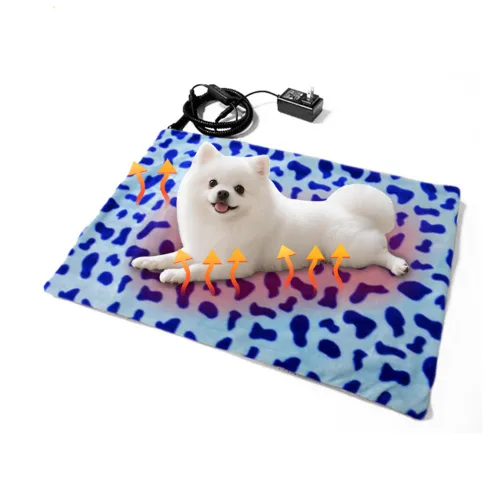
- Single configuration — W2037 is listed at 24W with no multi-level control mentioned. Best for a simple, low-cost entry SKU where the buyer wants predictable power draw.
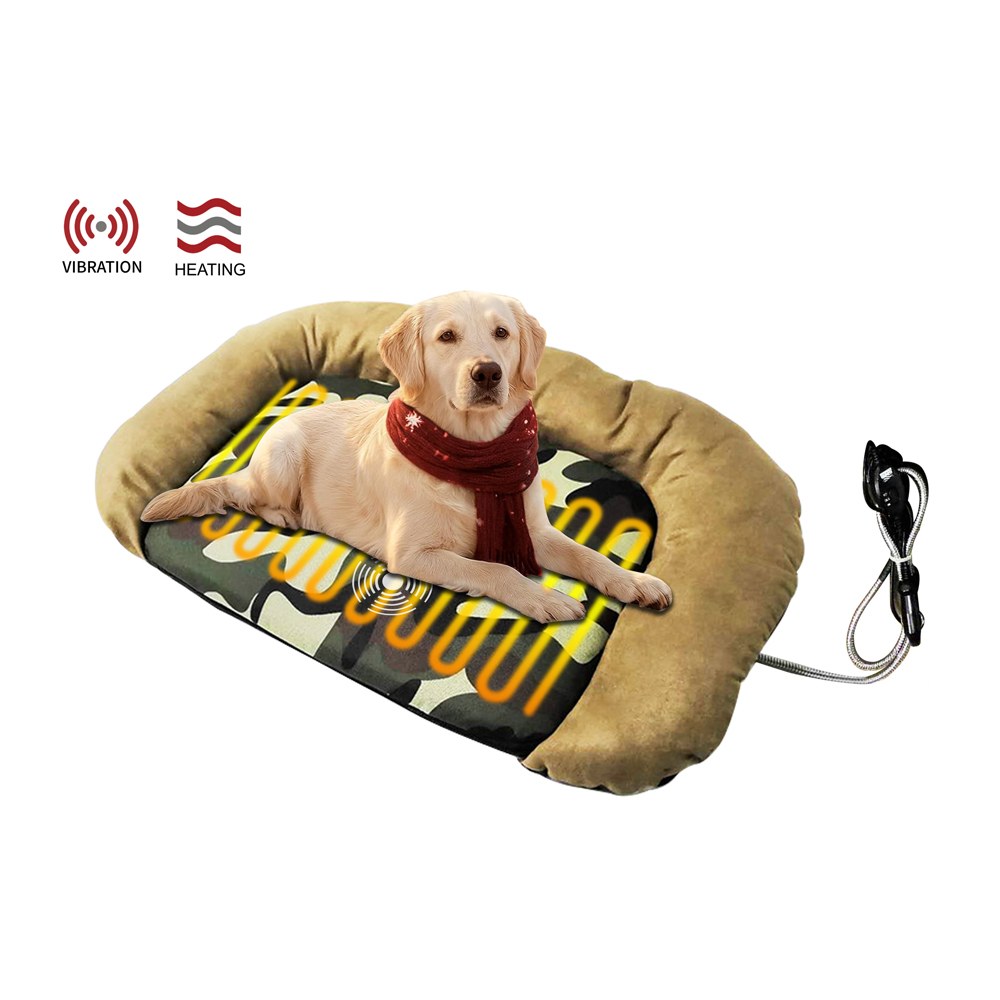
- H/L two-level heating — W2037M pairs heating with vibration massage and offers H/L heat settings. It has no timer, and the documentation notes the pad should be unplugged when not in use for long periods. That is a real limitation for retail: the instruction has to be built into your packaging and user manual.
- H/M/L three-level with timer — the Automatic Pet Heating and Massage Pad W2039MC-X-M adds timed control on top of heating and vibration massage. For large-dog shelters where the pad may run unattended, ask what running periods the timer supports and how it interacts with the H/M/L levels before you build a pitch around it.
Do not read a timer as an automatic shut-off guarantee. The timer governs a set running period; it is not a substitute for correct installation and an appropriate power supply. Keep both statements separate in your marketing copy, because the second is a safety claim that requires documentation you should request from the supplier.
Sizing and model selection
The W2037M is listed at 49.5 × 34.5 × 2.8 cm, which suits cats and small-to-medium dogs. The W2039MC-X-M is described as designed for large dogs; no dimensions are given for that model in the material available here, so request the drawing and measured dimensions for large-breed sizing rather than scaling up from the small pad. Fit matters more outdoors than indoors: in a doghouse the pad should sit within the floor footprint without being compressed against the walls, and the animal needs room to lie down beside the pad if it gets too warm.
| Buyer scenario | Suggested model | What to confirm before ordering |
|---|---|---|
| Simple indoor/outdoor pad, doghouse, cat bed; price-led SKU | W2037 (24W, 12V DC, chew-resistant cord) | Cord length; adapter plug standard; cover description for wet floors |
| Heated mat with massage, small-to-medium dogs, wipe-clean surface | W2037M (H/L, 49.5 × 34.5 × 2.8 cm, short-pile fabric + waterproof fabric + ABS) | No timer — confirm packaging instructions; cord entry sealing |
| Large-dog shelter, unattended running, three heat levels | W2039MC-X-M (H/M/L, timer, waterproof fabric) | Measured dimensions; timer range and settings; adapter rating |
Commercial terms and supplier confirmation
The reference models here carry an MOQ of 1,000 pieces and a bulk lead time of 45 days, subject to sales confirmation. Those figures are workable for a brand planning a seasonal container, but they are not small-batch numbers, so plan the SKU count before you commit: splitting 1,000 units across two heat-level variants is a different order from a single 1,000-unit run. The manufacturer, XIAMEN WELLNESSTECHNOLOGY CO., LTD, has operated since 2004 and runs an 8,200 m² facility, offering OEM/ODM services across its pet heating and cooling mat line — relevant if your range needs custom fabric, labeling or packaging rather than a catalog build.
Before you place a bulk order, the questions worth putting in writing are narrow and specific:
- Which layers in the cover stack are water-resistant, and how are seams and the cord entry sealed?
- What is the adapter's rated output, and which plug standards are available?
- For the timer model, what running periods can be set, and how does the timer interact with the H/M/L heat levels?
- What documentation accompanies the pad for the market you are selling into?
- Can a sample be supplied in the exact fabric and control configuration of the bulk order?
A sample in the final configuration is the cheapest way to settle the fabric, cord and control questions above. Specifications on a page describe what a pad is built from; a sample tells you whether that build suits your channel. Treat both as inputs to the decision rather than as proof of field performance, and keep your approved sample on file as the reference for incoming inspection. For incoming checks, hold the sample against four points: the fabric stack and easy-clean liner match the bulk build; seams and the cord entry are sealed the way the confirmed spec says; the adapter's rated output and plug match the purchase specification; and the timer, where fitted, cycles through its settable periods at every heat level offered.
What to do next
Decide your SKU ladder first — how many heat-level variants you will carry, which dog sizes you are addressing, and whether a timer is part of your proposition. Then build the inquiry around the layer stack, cord and adapter details, because those are where outdoor pads differ most between suppliers and where a vague spec costs the most to fix after production. If you are evaluating the models referenced here, start with the W2037 product page for the fixed-function pad and compare it against the two massage variants before requesting samples.